
Reviewed · WALKING TOURS
Private Prague Art Nouveau and Cubism Walking Tour
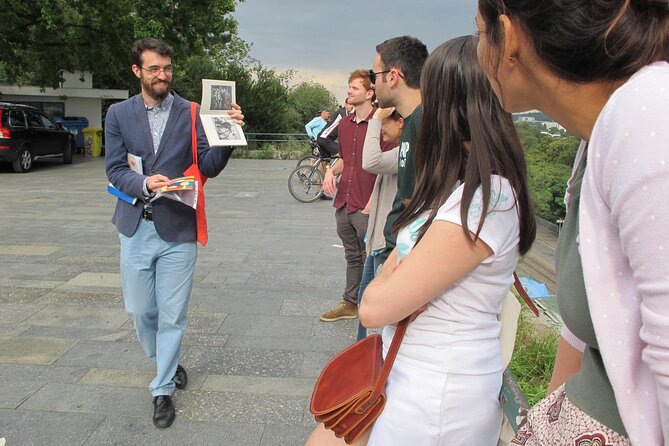
Prague loves big ideas in stone, and this private walk turns Art Nouveau and Cubism into a route you can actually see and sort in your mind. I like the way it starts at Praha hlavni nadrazi and then strings together street after street of style clues, so the architecture stops feeling random. I also like that the guide, Max Hutar of Prague Articulate, explains what you are looking at with story-driven comparisons that stick even if you know almost nothing about these styles. One possible drawback, there is real walking and the tour can run a bit longer than the listed 2 hours 30 minutes.
You will pass headline buildings from the early 1900s, from the Jerusalem Synagogue with its Moorish-inspired feel to the House at the Black Madonna, a flagship example of Prague Cubism. The stops are a mix of quick views and short transit hops, so you get variety without spending the whole day indoors, but you should expect many buildings to be mostly from the outside since some admissions are not included.
Key points to know before you go
- Art Nouveau to Cubism, in a single visual lesson across central Prague
- A private group for up to 15, so the pace can flex for your needs
- English mobile ticket and a route with short walks plus public transit links
- Several major facades and street details you can spot again on your own after the tour
- Some stop admissions are not included, so you will spend more time looking from the street
Why Prague Art Nouveau and Cubism work better together than apart
Most architecture tours split things into neat time periods, like they are separate museum rooms. This one is different, because Prague’s Art Nouveau and Cubism overlap in the city itself. You start in a world of flowing lines and decorative logic, then shift toward harder edges, geometric boldness, and a new kind of urban statement.
That matters for your brain. If you only see one style, it can feel like decoration. If you see both back to back, you start reading the city like a design language. Even if you are not an art person, you will begin noticing how window shapes, balconies, and rooflines act like visual grammar.
More walking tours in Prague:
- Prague: 3-Hour Walking Tour of Old Town & Prague Castle
★ 4.7 · 5,696 reviews - Prague: Ghost Walking Tour Where Legends Come To Life
★ 4.4 · 5,253 reviews - Prague: Jewish Quarter Walking Tour with Admission Tickets
★ 4.7 · 3,729 reviews
Meeting point and route flow: how the tour feels in real time
The tour meets at Prague Main Station, Wilsonova 300/8, Vinohrady. You finish at the Albertov tram stop area, and the same public-transport ticket used for the last leg stays valid long enough to get you back toward the core.
Expect a rhythm: short walks between stops, then quick transit segments to bridge distances. The listed time is about 2 hours 30 minutes, but the route does not perfectly match the sum of the stop times, because the walking and transit take their share. In plain terms, wear comfortable shoes and keep some flexibility in your schedule.
This is a private experience for your group only, up to 15 people. That is a big part of the value if you are traveling with family or friends, since you do not have to match someone else’s pace.
Value check: what you really get for $94.93 per group
The price is $94.93 per group (up to 15). That is a smart setup for small groups, and it can be a steal if your party is big enough to spread the cost.
Here is the practical way to look at it:
- If you fill close to 15 people, the per-person cost drops a lot.
- If it is just a couple of you, you are paying more per head, but you still get a private guide and a focused route.
You are paying for time and interpretation. The route is not just about seeing buildings, it is about understanding why those buildings look the way they do. The best part is that once you learn the pattern, you start spotting similar features around town without needing to book another tour.
Art Nouveau warm-up at Praha hlavni nadrazi and Senovážné náměstí
Your first big stop is Praha hlavni nadrazi, Prague’s Central train station. It opened in 1909 and has that classic Art Nouveau spirit of early modern public buildings. The hall and corridors are the showpiece, and the fact it is recently reconstructed adds to the wow factor when you are standing inside.
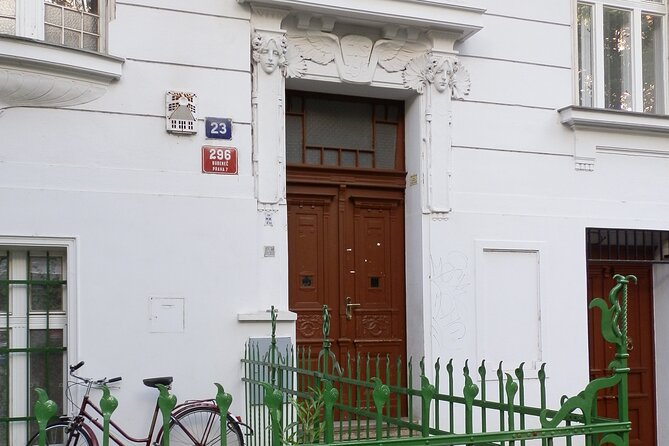
From there, you move toward Senovážné náměstí, where you can see three luxurious Art Nouveau apartment buildings. This is the kind of stop that teaches you to look at everyday architecture. Instead of only famous monuments, you learn how private buildings carried the same design ideas into daily life.
More private tours in Prague:
- Prague Old Town: Private Tour
★ 5.0 · 1,223 reviews - Prague Airport Private Arrival Transfer
★ 4.5 · 991 reviews - Prague Airport Private Departure Transfer
★ 4.5 · 780 reviews - Discover Prague Private Tour – 3 hours
★ 5.0 · 705 reviews
What to watch for
At these first stops, train your eye on the transitions: curved details, ornament that looks purposeful instead of random, and the overall sense that the building is making an argument about taste.
A quick reality check
You can admire most of this without going deep inside, but the tour notes that some admissions are not included later on. So think of the whole walk as a guided visual education, with a few optional or paywalled interior moments depending on the stop.
A Moorish-meets-modern stop at the Jerusalem Synagogue
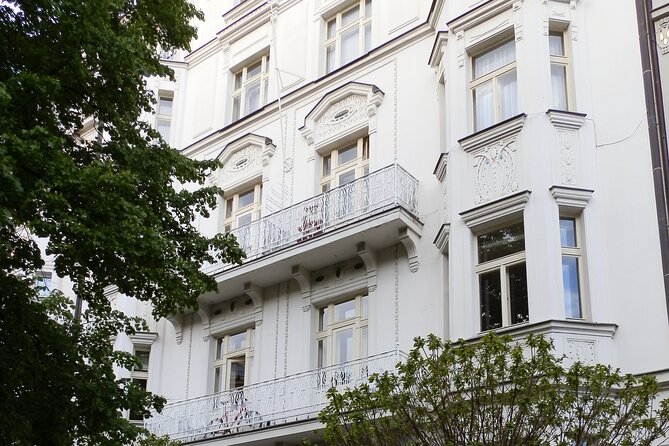
Next up is the Jerusalem Synagogue from 1906. It is described as traditional Moorish style typical for synagogues, but it also includes elements of Art Nouveau from the same era.
That combination is exactly why this tour works. Prague did not treat cultures and styles like locked boxes. Instead, architects borrowed, adapted, and blended. You get a lesson in how cities reinvent themselves while still respecting tradition.
The tour lists admission as not included for this stop. Practically, that means you should be ready to view what you can and, if you want more interior access, plan to pay at the site if it is offered.
Hotel Central (Hybernska 10): early Art Nouveau in a smaller, sharper form
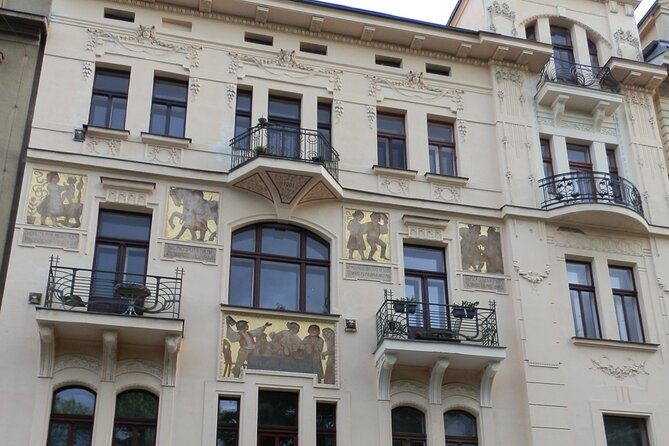
At Hybernska 10, you see the Hotel Central Palace, dating to 1899. It is one of Prague’s earliest Art Nouveau buildings, so it is useful as a baseline. Earlier examples often look different from later ones. You can spot how the style was still finding its voice.
This is also a good contrast stop after the station. Train stations can go for grand scale. A hotel facade tends to emphasize urban elegance, and it helps you understand how the same design ideas shift depending on the building’s purpose.
Obecní dům, then the Cubist turn at the House of the Black Madonna
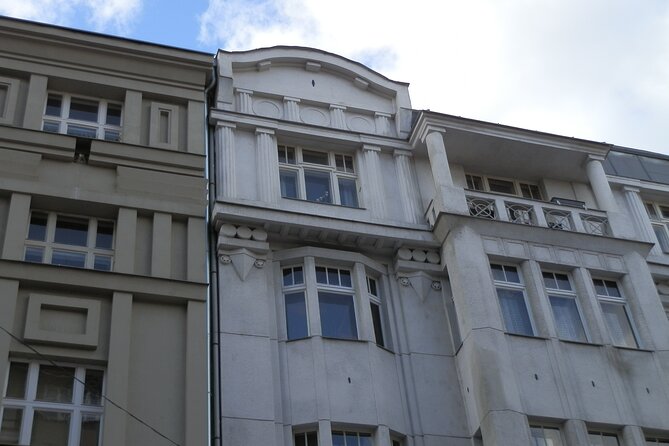
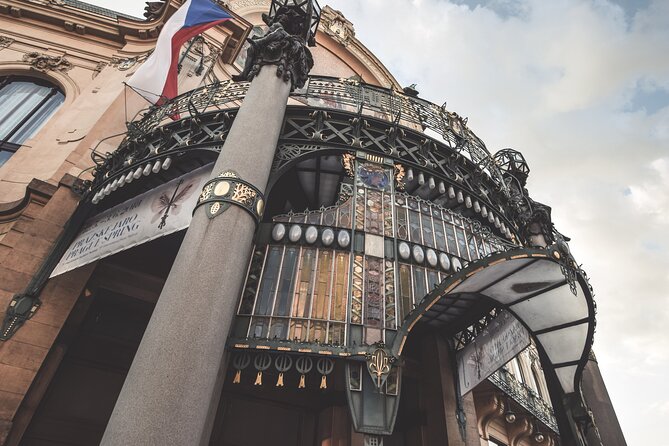
Now you reach the cultural heavyweight: Obecní dům (Municipal House). Projected in 1905, it has stayed as Prague’s house of culture and representation. The tour frames it as one of the biggest and most important Art Nouveau pieces in the city.
From there comes the stylistic pivot: the House at the Black Madonna, built in 1912. This is presented as a flagship of Cubist architecture, pioneered by Prague architects in the years before World War I. In other words, you go from flowing, ornate Art Nouveau confidence to Cubism’s more fragmented, angular confidence.
The big takeaway you want as you walk is how the city’s look changes when you go from decoration-first design to structure-first design. At Obecní dům, you feel the building thinking about beauty. At the Black Madonna, you feel the building thinking about form.
Some of these later stops list admission as not included, so again, consider the street view as part of the deal. The facades are doing a lot of the work.
Na Příkopě and the cubist street furniture lesson (Emil Kralíček’s lamppost)
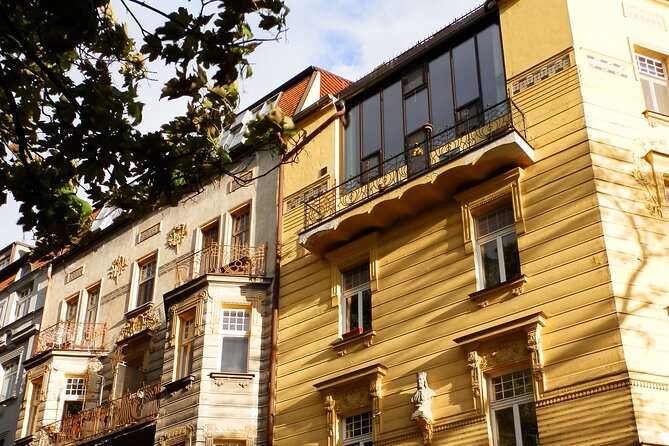
On Na Příkopě, the boulevard between Old Town and New Town, you get Art Nouveau banking and other civic buildings. This is where you start seeing the style at the scale of daily power and commerce, not just public squares or landmark institutions.
Then you pause for a small but memorable object: Emil Kralíček’s Cubist Lamppost. This is one of those details that makes you rethink Cubism. It is not only for buildings. It turns up in street furniture, where the geometry is immediate and playful in a slightly rebellious way.
Why this lamppost matters
It trains your attention. Once you notice Cubism in a lamppost, the next time you look at a facade, you start seeing the same logic in balconies, corners, and window groupings. That is the kind of skill you keep after the tour ends.
Václavské náměstí and Vodičkova: a city block where styles collide
You reach Václavské náměstí (Wenceslas Square), a central square with Art Nouveau hotels and department-store architecture. The tour gives this stop extra time, about 20 minutes, because squares let you step back and compare.
Then you head to Vodičkova, where multiple stunning Art Nouveau and Cubist buildings line the street. This is where the guide’s style recognition matters most. If you are learning to see, you need a stretch of real facades to scan. Vodičkova gives you that.
This section is also practical because it helps you map the city. After a stop like this, you can look at the same buildings from different angles and start predicting what design features you will notice next.
Three Cubist Houses near Vyšehrad: the triple shot that locks in the idea
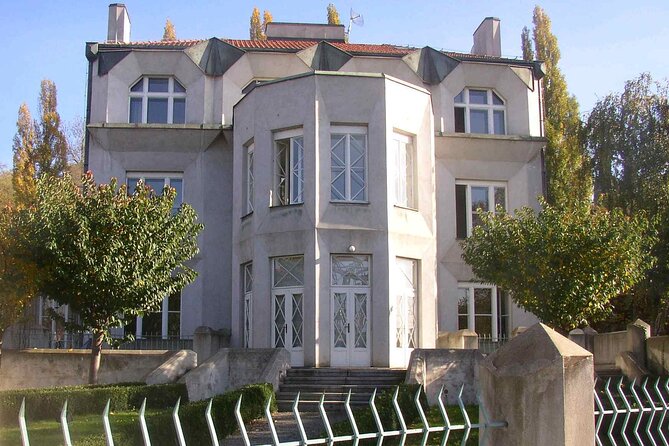
The tour takes you to Three Cubist Houses, a famous triplet of homes under the rock of the Vyšehrad fortress. Group shots are powerful teaching tools. When you see three related examples side by side, you stop asking whether Cubism is strange and start understanding how consistent the style is.
The tour notes admission is not included here, so your focus is on the exterior forms. That is fine. Cubist architecture in Prague is designed to be read from the street, with the geometry and massing doing the talking.
Villa Kovařovic at the Vltava river: Gothic and baroque energy inside a Cubist shell
Next is Villa Kovařovic, built in 1912 at the Vltava river banks. The description is clear: it blends Gothic and baroque inspiration with a Cubist masterpiece approach.
This stop is important because it shows Cubism in Prague was not just about breaking shapes. It could also house older aesthetic ambitions. You end up with a building that feels like it has multiple influences arguing politely with each other.
Admission is listed as not included, so you will likely spend most of your time taking in the exterior and the setting near the river, where the lines show up strongly.
Neklanova street to the finish: a final Cubist apartment clue
The tour ends with Neklanova, a street with an amazing Cubist apartment building from 1913. It is a fitting closer because apartment architecture is what you live with. The style is not only for monuments or wealthy institutions. It becomes normal city housing.
This last stretch also helps you tie the route together. If you paid attention earlier, you should start catching the Cubist cues on your own by now: how corners look, how windows are grouped, and how balconies and edges create a kind of rhythm.
What I think you will walk away able to do
By the end, you should be able to do something useful on your own time in Prague. You will not just say this is Art Nouveau or this is Cubism. You will recognize the features that make it so.
The standout strength here is the guide’s ability to connect details to big ideas. The tour is also private, so if you have questions about what you are seeing, you can ask without feeling rushed by the schedule of a larger group.
Also, the mix of major architecture and smaller street-level design points, like the lamppost, means you get both scale and nuance.
Should you book this Prague Art Nouveau and Cubism walking tour?
Book it if you want a focused, design-first introduction to Prague, and if you like learning how to look. This is especially good value when your group is large enough to spread the $94.93 price, and it is a strong pick for couples, architecture fans, and families who enjoy seeing the city through a theme.
Skip it or consider pairing it with lighter sightseeing if you hate walking, since the route does involve real strolling and the timing can run long. Also, if you expect mostly inside visits, note that multiple stops list admission as not included, so plan on a street-facing experience.
If you want a tour that helps you come away recognizing styles rather than just collecting photos, this one is a solid choice.
Recently reviewed around Prague
- Savor 10 Course Dinner in Chef’s Kitchen★ 5.0 · 20 reviews
- Prague for Men★ 5.0 · 11 reviews
- Private Lesser Town tour – Historical Treasure Hunt★ 4.5 · 7 reviews
- Photographer in Prague – Couple, engagement & portrait photoshoot★ 5.0 · 22 reviews
- Ebike Sunset tour of Prague★ 5.0 · 19 reviews
- 1-Hour Ride Across the Prague in Mini Hot Rod Car★ 5.0 · 37 reviews
- The Best of – private tour with PERSONAL PRAGUE GUIDE★ 5.0 · 107 reviews
- Prague on Stylish Retro styled E-Bike – Viewpoints & Sightseeing★ 5.0 · 20 reviews
Walking Tours, compared.
3-Hour Walking Tour of Old Town & Prague Castle
Read our review →
Ghost Walking Tour Where Legends Come To Life
Read our review →
Jewish Quarter Walking Tour with Admission Tickets
Read our review →
Prague Guided Walking Tour and Cruise with Authentic Czech Lunch
Read our review →
Old Town and Jewish Quarter Guided Walking Tour
Read our review →
Prague Ghost and Legend of Old Town Walking Tour
Read our review →
Prague 3-hour Afternoon Walking Tour including Prague Castle
Read our review →
Ghosts and Legends Nighttime Guided Walking Tour
Read our review →Browse the lists this tour appears in