
Reviewed · WALKING TOURS
Prague Art Nouveau and Cubism Walking Tour
Prague’s Art Nouveau and Cubism feel like two different planets, yet this walk shows how they coexisted in one city. I especially like the small-group feel and the way the guide explains how design connects to history, politics, and daily life. One possible drawback: you will spend a lot of the 3 hours outside and on your feet, so plan for weather and comfortable shoes.
The route is built for focus. I like that it mixes big public landmarks with a few places most people do not notice, and you end close to easy food options near attractions. You will get a historian guide, optional morning or afternoon departure, and a format that can be tailored on the fly, with guides such as Vadim, Betty, Matous, and Bonita often shaping the pacing around the group.
Key points to know before you go
- Up to 8 travelers keeps the tone conversational, with room for questions
- Art Nouveau vs Cubism in one route helps you spot what changed and why
- Stops are mostly ticket-free based on the listed entry notes for each stop
- Construction and tech stories add real-world context to pretty façades
- Guide tailoring happens often (including pacing and routes, even taking a tram when needed)
- Lucerna Bar and the Czech Modern vibe give the tour a satisfying finale
Why Art Nouveau and Cubism Fit Together on One Prague Walk
Prague in the early 1900s was a design laboratory. You can see it in the curves and ornament of Art Nouveau, then turn a corner and hit the sharp geometry of Cubism. The best part of this tour is that it does not treat these as separate museum categories. Instead, you get a quick sense of how Czech artists and architects absorbed other influences, including Eastern aesthetics, and turned them into something very local.
I like that the guide points out specific visual tells so you can keep scoring the buildings after you move on. For Art Nouveau, you might look for things like ginkgo-style leaves, flowing details, elaborate light fixtures, and curvy typography. For Cubism, you start noticing crystal-like forms and pyramids, with Prague once described as a major center for Cubist art in Europe.
More walking tours in Prague:
- Prague: 3-Hour Walking Tour of Old Town & Prague Castle
★ 4.7 · 5,696 reviews - Prague: Ghost Walking Tour Where Legends Come To Life
★ 4.4 · 5,253 reviews - Prague: Jewish Quarter Walking Tour with Admission Tickets
★ 4.7 · 3,729 reviews
Price, time, and what you get for $126.71
At $126.71 for about 3 hours, this is not a bargain-basement walking tour. But you are paying for a historian guide and a tight route that covers a lot of architectural ground without turning it into a sprint. The group limit of 8 matters here. In a larger crowd, you usually lose question time, and you miss details. Here, guides like Vadim and Matous are known for answering questions and guiding you to sights most tourists do not naturally step into.
You also get good value in the “stop quality per minute” sense. Many of the locations are major Prague landmarks, but the pacing includes smaller interiors and reference points that help you read the city like a book. Food is not included, so you will likely end at Café Louvre or later grab something nearby at your own pace, which is a normal way to do architecture tours.
Meeting at Ovocný trh 19 and ending at Café Louvre
You start at Ovocný trh 19 in Staré Město, near the old-town core. The location is practical, because it keeps you close to the action and near public transportation. You finish at Café Louvre on Národní 22, right by the center of Prague’s tourist and restaurant zones.
The café is part of why the ending works. Café Louvre opened in 1902, and it is famous for the old Prague atmosphere, with figures like Kafka, Albert Einstein, and T. G. Masaryk connected to the place. Even if you only pop in for a quick drink or sit for a few minutes, it gives you a fitting “turn-of-the-century” atmosphere to close on.
The small-group format, and why up to 8 travelers changes everything
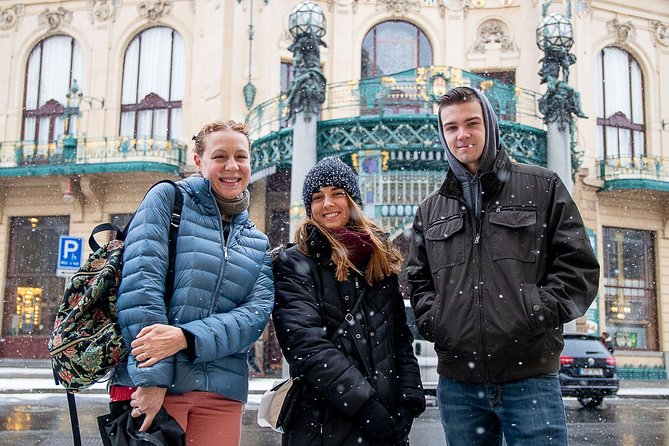
This tour caps at 8 travelers, which is rare for a route that covers this many named stops. With a small group, the guide can actually adjust. In the feedback you can see it happening: guides have tailored tours to the group’s interests and walking pace, and one guide even suggested taking a tram to reach an area to explore more efficiently.
That tailoring is more than comfort. It helps you connect the architecture you see. If you care about Cubism, the guide can spend a bit more time drawing attention to the angles, the “crystal” sense, and the symbolic role of those forms in Czech cultural identity. If you care more about Art Nouveau, you will get more of the ornament and design-language clues, like those ginkgo-style details on façades.
And because it stays interactive, you get better at noticing on your own. That is the real benefit of paying for the guide instead of just buying a phone audio app.
Same city, a completely different kind of day:
- Prague: 50-Minute Sightseeing Evening Cruise
★ 4.2 · 33,780 reviews - Prague: Medieval Dinner with Unlimited Drinks
★ 4.4 · 19,847 reviews - Prague: Castle Tour with Local Guide and Entry Ticket
★ 4.6 · 10,422 reviews - Prague Castle 2.5-Hour Tour Including Admission Ticket
★ 4.7 · 8,927 reviews
Construction tech you would miss if all you saw was decoration
A big reason this tour stands out is the way it treats architecture as engineering, not just style. The guide’s story includes construction technologies that shaped how people lived in modern Prague.
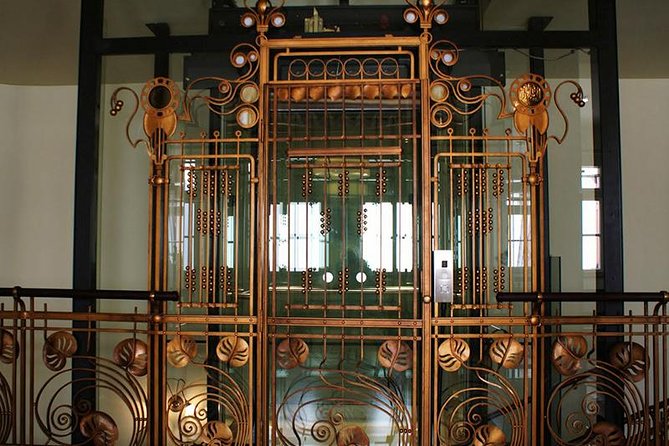
You might hear about central heating and ventilation. You might also learn how drinking water, hydraulic elevators, steam-powered laundry, and even an intercom system entered the picture. These details matter because they explain why Art Nouveau and related early modern design looked the way it did. Good design was not only about aesthetics. It was about comfort, convenience, and an imagined future.
This also helps you compare styles more fairly. Instead of thinking Cubism is only about being angular or Art Nouveau is only about decoration, you start seeing both as responses to the same modern pressures, economic ambition, and social change.
Stop 1: House of the Black Madonna, where Cubism starts making a point
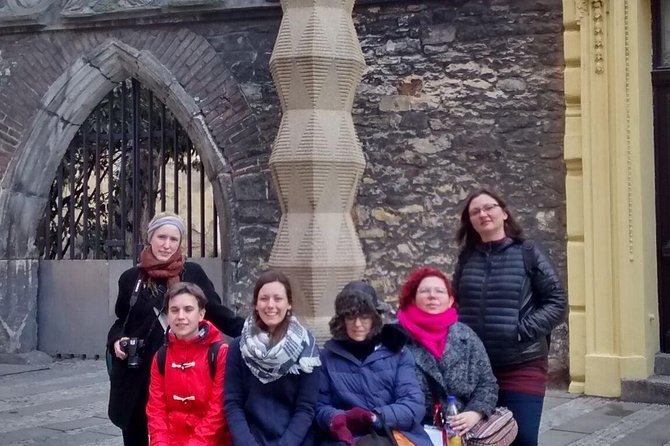
You begin with the House of the Black Madonna, a unique building in Cubist style. The stop is short, about 10 minutes, but it sets the contrast right away. Cubism is not polite. It is built from broken planes, heavy angles, and a sense of rearranging the world.
What I like about starting here is that it forces your eyes to wake up. Instead of waiting for ornament, you learn to “read” structure and form first. That makes the later Art Nouveau stops more satisfying, because you can spot the shift in priorities, from playful curves and symbolism to geometry that feels almost crystallized.
This stop is listed as admission ticket free, so you are mostly using your time for observation and context rather than dealing with entry procedures.
Stops 2 to 4: Obecní dům, K+K Hotel Central, and Café Imperial
After the Cubist opening, the route moves into major Art Nouveau territory.
Stop 2: Obecní dům
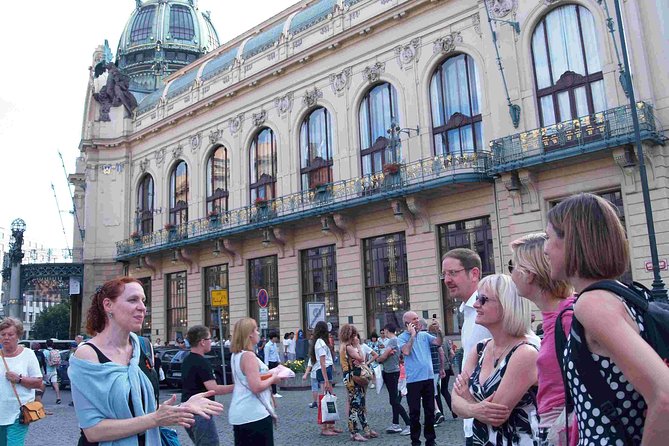
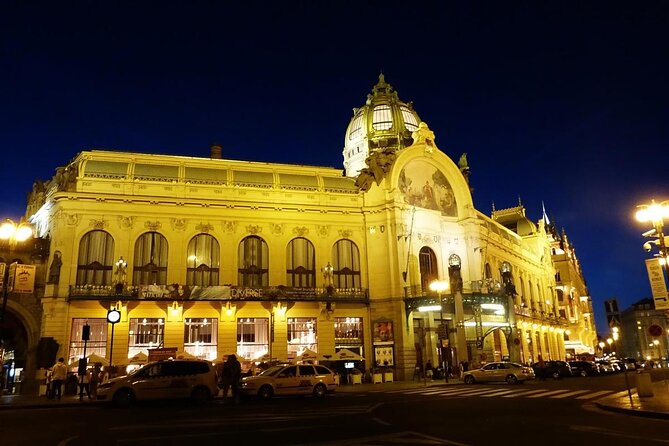
Obecní dům is an iconic Czech Art Nouveau landmark and your next stop, about 15 minutes. This is the kind of building where the guide helps you slow down. You are not just looking at pretty façades. You are learning why Art Nouveau became a public statement.
If you want to understand the style fast, spend your attention on the way shapes and ornament feel integrated, not pasted on.
Stop 3: K+K Hotel Central Prague
Next is K+K Hotel Central Prague, described as the first Art Nouveau building in Prague. You get about 10 minutes. This is a strong stop for connecting design to modern life, because hotels and public buildings were part of how Prague projected itself to the world.
In your head, keep the earlier construction-tech theme. These buildings often signaled modern comfort and confidence, and the guide tends to connect that mindset to the look.
Stop 4: Café Imperial
Then you reach Café Imperial, with a unique Art Nouveau interior. The stop is brief, about 5 minutes, but it can be one of the most memorable moments because interiors show the style at full volume. If you are the kind of traveler who normally walks past decorative spaces, this quick interior look is a wake-up call.
Practical tip: keep your phone or camera ready, but focus first on patterns, lines, and how the room is arranged. The design language is more readable than a single photo.
All three of these stops are listed as admission ticket free, so your time mostly goes into observation with the guide’s commentary.
Stop 5: Czechoslovak Legion Bank and Prague identity in Cubist form
Stop 5 is the Czechoslovak Legion Bank, about 10 minutes. It is noted for unique Cubist architecture and an interior dedicated to the Czechoslovak Legion of the First World War.
This stop is valuable because it links Cubism to memory and national identity. Cubism is easy to treat as just a visual experiment. Here, it is tied to storytelling and commemoration, which gives the style a sharper meaning.
If you are the type who likes context, this is a good moment to ask the guide questions. It is the point where design starts to feel political and emotional, not just fashionable.
Stop 6: Praha hlavní nadrazi, and the beauty of the Art Nouveau dome
Next comes Praha hlavní nadrazi, Prague Main Train Station. You spend about 10 minutes here, and the highlight is the magnificent interior Art Nouveau dome.
This is one of those places where many travelers rush through just to get somewhere else. On this tour, it becomes a design lesson. Train stations are perfect for studying architecture as a public-facing technology. People moved through them every day, so style and function had to work together.
A guide may also show you how to navigate the main station in a practical way. That kind of help can save you stress later, especially if your plans involve trains or connections.
Stop 7: Wenceslas Square, Art Nouveau vs Art Deco in real time
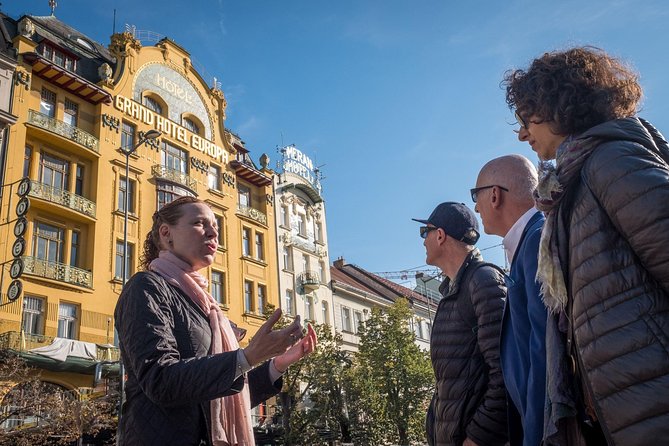
Wenceslas Square is about 15 minutes. The tour focuses on discussing Art Nouveau and Art Deco architecture here.
This is not a “look up, period” stop. The guide helps you compare styles by spotting differences in ornament and overall design approach. It is also a good way to understand how Prague moved from one design mood to another as decades progressed.
If you want to practice your “spot the style” skill, this stop is a chance to do it with feedback from the guide.
Stop 8: Lucerna Music Bar, the most fun kind of history
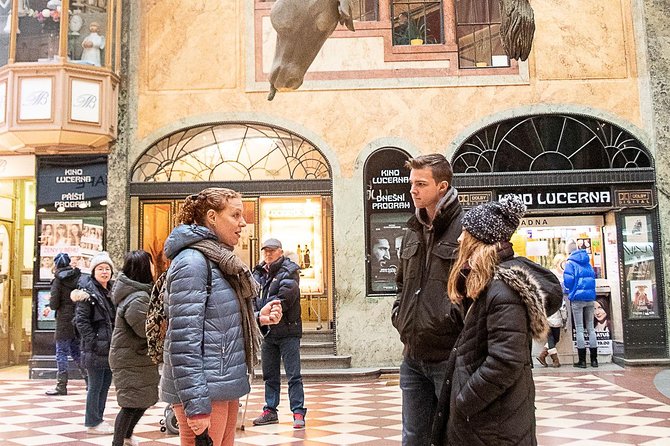
Stop 8 is Lucerna Music Bar, about 10 minutes. You get to view the Art Nouveau interior of what is described as the most beautiful arcades of Prague.
I like this stop because it shows optimism and design confidence. Art Nouveau is full of forward-looking energy, and places like this were built for experience, not just function. Even if your taste is more modern, this interior is a reminder that people once believed design could lift everyday life.
It is also a nice tonal shift before the final city symbolism stop.
Stop 9: the Upside-Down Statue, symbolism you will keep thinking about
The last stop is the Upside-Down Statue of King Wenceslas riding a Dead Horse, about 10 minutes. The focus is symbolism in the context of Czech history and the Czech National Revival.
This closing stop gives your architecture learning a cultural backbone. It is not just more style. It is a message, and it helps you understand why Prague’s art, architecture, and public symbols all mix with national identity.
What the best guides do during this walk (and why you should care)
A repeat theme in the strong feedback is how engaging the guides are, plus how they tailor the day. Names you may hear associated with this tour include Vadim, Vad, Matous, Betty, and Bonita.
What stands out is the combination of structure and spontaneity. The guide has a plan, but they also want your questions. People also mention that guides point out places most tourists do not stumble into, including interesting interiors and details you might miss from the sidewalk.
That is the secret value here. Architecture tours often stop at description. This one leans into interpretation: what the style means, what it signals about the era, and why it matters in Prague today.
Who should book this tour
Book it if you:
- Want a clear way to understand Art Nouveau vs Cubism in Prague, not just a list of buildings
- Like architecture explanations that connect to history and politics
- Prefer a smaller group so you can ask questions and get help
- Enjoy interiors as much as exteriors, even if some stops are short
Skip it (or consider a different style tour) if you:
- Have limited mobility or hate walking outdoors for about 3 hours
- Want a long sit-down experience with food included, because this tour is mainly about walking and looking
- Expect long entry times everywhere. Most stops are timed to keep the whole loop cohesive
Should you book this Prague Art Nouveau and Cubism Walking Tour?
Yes, if you want Prague architecture to make sense quickly. The route is packed with major landmarks, then it adds enough interpretation that your eyes start working differently by stop two. The small-group size and the consistent guidance around noticing details are the strongest selling points, and the Cubism-to-Art-Nouveau contrast keeps you from zoning out.
If you are on the fence because of the price, think of it like this: you are not just paying to see buildings, you are paying to learn how to read them, plus get a guide who can tailor pace and questions. For many people, that is the difference between seeing Prague and really understanding it.
FAQ
How long is the Prague Art Nouveau and Cubism Walking Tour?
It runs for about 3 hours.
What is the price per person?
The price is $126.71 per person.
Is the tour in English?
Yes, the tour is offered in English.
How big is the group?
This tour has a maximum of 8 travelers.
Where do you meet and where does it end?
You meet at Ovocný trh 19, Staré Město, Praha-Praha 1, and the tour ends at Café Louvre, Národní 22, Praha 1-Nové Město.
What is included in the tour price?
A historian guide is included.
Is food included?
No. Food and drinks are not included unless specified.
Are the stops ticketed?
The listed stops show admission ticket free for each site on the route, so you typically do not need to buy entry tickets for those stops.
What is the cancellation window?
You can cancel for a full refund up to 24 hours in advance of the experience start time.
Recently reviewed around Prague
- Savor 10 Course Dinner in Chef’s Kitchen★ 5.0 · 20 reviews
- Prague for Men★ 5.0 · 11 reviews
- Private Lesser Town tour – Historical Treasure Hunt★ 4.5 · 7 reviews
- Photographer in Prague – Couple, engagement & portrait photoshoot★ 5.0 · 22 reviews
- Ebike Sunset tour of Prague★ 5.0 · 19 reviews
- 1-Hour Ride Across the Prague in Mini Hot Rod Car★ 5.0 · 37 reviews
- The Best of – private tour with PERSONAL PRAGUE GUIDE★ 5.0 · 107 reviews
- Prague on Stylish Retro styled E-Bike – Viewpoints & Sightseeing★ 5.0 · 20 reviews
Walking Tours, compared.
3-Hour Walking Tour of Old Town & Prague Castle
Read our review →
Ghost Walking Tour Where Legends Come To Life
Read our review →
Jewish Quarter Walking Tour with Admission Tickets
Read our review →
Prague Guided Walking Tour and Cruise with Authentic Czech Lunch
Read our review →
Old Town and Jewish Quarter Guided Walking Tour
Read our review →
Prague Ghost and Legend of Old Town Walking Tour
Read our review →
Prague 3-hour Afternoon Walking Tour including Prague Castle
Read our review →
Ghosts and Legends Nighttime Guided Walking Tour
Read our review →Browse the lists this tour appears in